Two notes before we dive in:
1: I'm hosting a free workshop on May 19th on how to make your company more profitable. Register here.
2: The self storage market is opening up and we have a few great deals under contract. If you're an accredited investor and you'd like to talk about investing with me - click here.
--
I have a controversial opinion:
Most entrepreneurs don’t end up owning a company.
They end up owning a job. They run around doing everything. They are servicing customers, putting out fires, solving problems, and trading their time for money forever.
It’s not because they’re not smart enough. It’s not because they don’t work hard enough. And it’s usually not even because they start the wrong business.
It’s that they don’t work on the right things.
They focus on what’s urgent and right in front of them instead of taking action on work that is important for the long term growth of the company. They don’t do the intellectually hard things.
They don’t have difficult conversations. They don’t get uncomfortable and make moves on sales and hiring and delegation.
They make the same mistakes and decisions over and over again but expect different results. They aren’t good communicators or salespeople. They don’t address fundamental problems when they arise and assume that they will just work out over time.
We all know this business owner. I have a friend from college who is this business owner.
He runs a pizza restaurant in his home town in Florida. It is on the best corner and is a beloved staple of the community. And they crush it.
He makes $250,000 per year from this one, 1,500 square foot restaurant. He does very well and is building a great life for his family.
He has taken the proceeds and bought some real estate and made other great investments. He lives in a nice house and his kids go to private school despite the fact that he grew up an immigrant and his parents came here with nothing.
But here’s the interesting thing: he gets called in every Thursday, Friday, and Saturday night by his management team to help make pizzas when they get busy.
He is stressed to the max. Every time I see him I ask him about business, and he begins to complain. About people. Customers. Equipment. Management.
My people suck. I can’t find any good help. I can’t afford a good manager. My customers are entitled and obnoxious. This is a hard business.
But why? I can’t help but think.
Many pizza chains are owned by people who aren’t in the store flipping pizzas when things get busy. Many managers who make $60,000 a year or less can run a pizza business and manage the staff with a little oversight or help from the owners.
And many owners have figured out how to avoid owning a job so that they can own a business that makes them money while they do other things.
Don’t get me wrong, the restaurant business isn’t easy, but I’ve seen many brands scale up to 20+ restaurants and staff all of them without the owners needing to be there. So I don’t buy it.
My friend is stressed to the max and flipping pizzas every weekend because he works on the urgent things, but he doesn’t work on the important things.
So let me introduce you to the four quadrants of time management.
There are four types of activities with different levels of importance and urgency.
The left side of the quadrant is urgent. These things must be done by somebody now. There are important, urgent things and non-important and non urgent things.
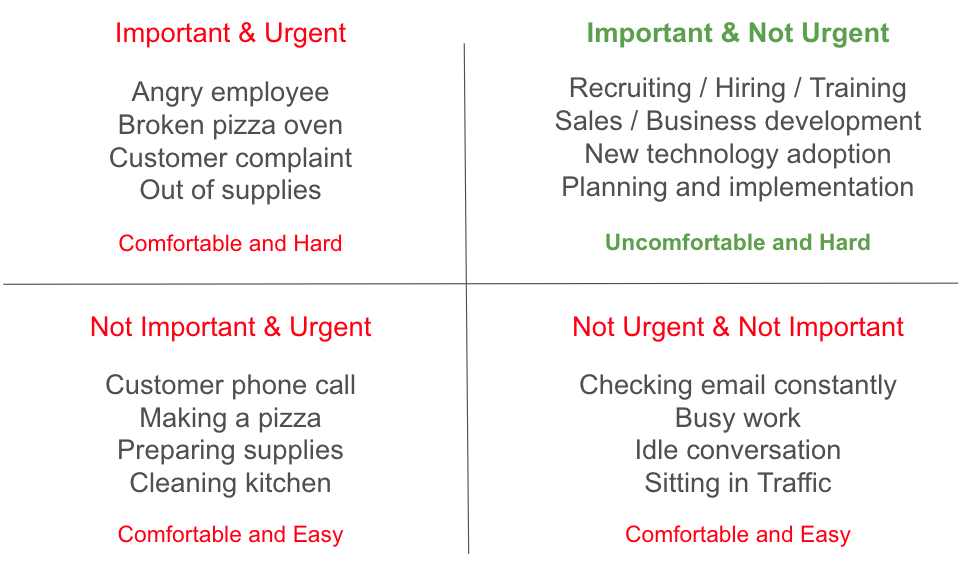
Here is the matrix using my friend’s pizza business as an example:
Urgent and important things must be done now. They cannot wait.
An employee calls with an issue. Your equipment malfunctions, and business comes to a screeching halt. A customer is upset and calls or emails you. You run out of supplies, and you can’t fulfill orders.
These are fires, and as a business owner, it’s up to you to put them out right away or your business will suffer. However, everyone deals with this kind of thing—it’s normal.
Problem solving is a huge part of being successful, and these issues aren’t necessarily scary or uncomfortable even if they are hard to deal with.
Urgent and not-important tasks can still be critical to the business, but they’re easily delegated as your business grows.
Don’t get me wrong here, every business owner needs to spend time here, especially in the beginning, but as time goes on and you hire the right people and put the right systems in place, the business owner or CEO will spend less and less time here.
My friend who runs the pizza shop spends almost all of his time in these quadrants 1 and 3. All urgent stuff. He is putting out fires and solving problems and doing the work necessary to run the business.
He makes pizzas when he is short-handed. He is answering the phone when nobody is at the register. He runs to the store to get supplies if he runs out.
Too many business owners spend too much time here because it feels very productive. It is comfortable and easy. It is the default thing to do.
Go to work and do the job. Flip the pizzas. Answer the customer service calls. Delegating is hard and getting somebody else in place to do the work isn’t easy, so a lot of business owners default to staying right here.
Get out of my way, I’ll handle it.
Not urgent and not important tasks are time wasters. Repeatedly checking emails or social media. Small talk or sitting in traffic. Busy work around the office that doesn’t move the needle forward.
This stuff should be removed from your schedule. All those tasks may make you feel important, but they are crutches and time wasters. And most people use them to avoid doing hard things.
Here’s the cold hard truth:
Important but not urgent is the key to your business growth.
Almost every single good thing that has ever happened in my business has come as a result of spending time in the Important but not urgent quadrant.
You need to take this concept more seriously if you want to grow.
--
A few posts from this week:
--
--
--
--
The #1 secret to growing a successful business in 2026 is hiring offshore talent. I've hired 400+ across my portfolio from Somewhere.com and it's changed my life.
You can get phenomenal operators for 80% less than US equivalents. Want $500 off your next hire? Just respond to this email and I'll hook you up!
Onward and upward,
Nick Huber

.gif)
